
Why Design Manufacture and Install Works
A fitted wardrobe can look simple when it is finished. Doors line up neatly, awkward corners disappear, and suddenly the room feels calmer and easier to live in. What most homeowners do not see is how much depends on getting the early decisions right. That is where a design manufacture and install approach makes a real difference.
For bedroom storage, every stage affects the next one. If the design does not reflect how you actually use the room, the wardrobe will never feel quite right. If manufacturing is treated as a separate step with little thought for the space itself, details can be missed. If installation is left to someone who was not involved from the beginning, small issues can become expensive ones. Keeping the whole process together is often what turns a good idea into a fitted result that genuinely works.
What design manufacture and install really means
At its simplest, design manufacture and install means one company takes care of the project from first conversation to final fitting. That includes measuring the room, shaping the design around the customer, making the wardrobe to suit those exact dimensions, and then installing it properly on site.
That may sound straightforward, but it changes the whole experience. Instead of trying to coordinate a designer, a supplier and an installer, you deal with one team that understands the room, the brief and the finished goal. There is less repetition, fewer crossed wires and more accountability from start to finish.
For homeowners, that matters because fitted furniture is not a standard purchase. It is tied to the quirks of your house. Ceiling height, skirting boards, chimney breasts, alcoves, sloping ceilings and uneven walls all affect the final build. A wardrobe that looks excellent on paper still needs to work in the real room.
Why it suits fitted wardrobes so well
Freestanding furniture is made to suit the average space. Fitted wardrobes are not. They need to make full use of the room you actually have, not the room a manufacturer imagines you have.
That is why fitted storage benefits so much from a joined-up process. The design stage can take into account how much hanging space you need, whether drawers are better than shelves, how to handle dead corners, and what style will sit comfortably with the rest of the bedroom. From there, manufacture can follow that plan precisely rather than forcing the design to fit stock sizes.
Installation then becomes the final part of the same thinking, not a separate trade trying to make pre-made pieces work. That often leads to a cleaner built-in finish, better use of wall-to-wall space and fewer compromises around awkward areas.
The design stage sets the tone
A well-designed wardrobe is not only about appearance. It is about how the space will feel on an ordinary weekday morning when two people are trying to get ready, or how easy it is to keep a family bedroom tidy when life is busy.
This is where practical questions matter. Do you need long hanging for dresses or coats? More double hanging for shirts and jackets? Easy-access drawers for children? Open shelving for bags and folded items? A place to hide laundry or spare bedding? Good design solves these details before anything is made.
There is also the visual side. Door style, panel layout, finishes and colours need to suit the room rather than dominate it. In a smaller bedroom, the wrong choice can make the space feel heavier. In a larger one, too little detail can leave the fitted furniture looking flat. Getting that balance right takes experience, but it also takes listening.
That is one of the strengths of a service-led approach. The customer is not picking blindly from a flat-pack range. The design can respond to how they live and what they want the room to do.
Manufacture brings the design into the real world
Once a design has been agreed, the next challenge is making it accurately. This is where bespoke manufacturing earns its place.
A made-to-measure wardrobe is not simply a standard unit with filler panels added afterwards. It is built with the room in mind. Heights, widths, internal layouts and finishing details are planned so the final result feels intentional. That usually gives a more polished look than trying to adapt off-the-shelf furniture to a space it was never designed for.
There is also a quality point here. Manufacturing linked closely to the design tends to reduce avoidable errors. If measurements, materials and layout are all being handled in one connected process, there is less room for confusion. That does not mean every project is identical or every room is easy. Older homes and awkward spaces can still bring surprises. But when the people making the furniture understand the brief from the start, those challenges are easier to manage sensibly.
For homeowners, the benefit is simple. The finished wardrobe is more likely to fit properly, look right and do the job it was meant to do.
Why installation should never be an afterthought
Even the best wardrobe design can be let down by poor fitting. Installation is where all the planning is tested.
Walls are not always straight. Floors can slope slightly. Ceilings can vary more than expected from one side of a room to the other. In fitted furniture, precision matters because every gap, line and join is visible. A rushed or inexperienced installation can spoil the final effect.
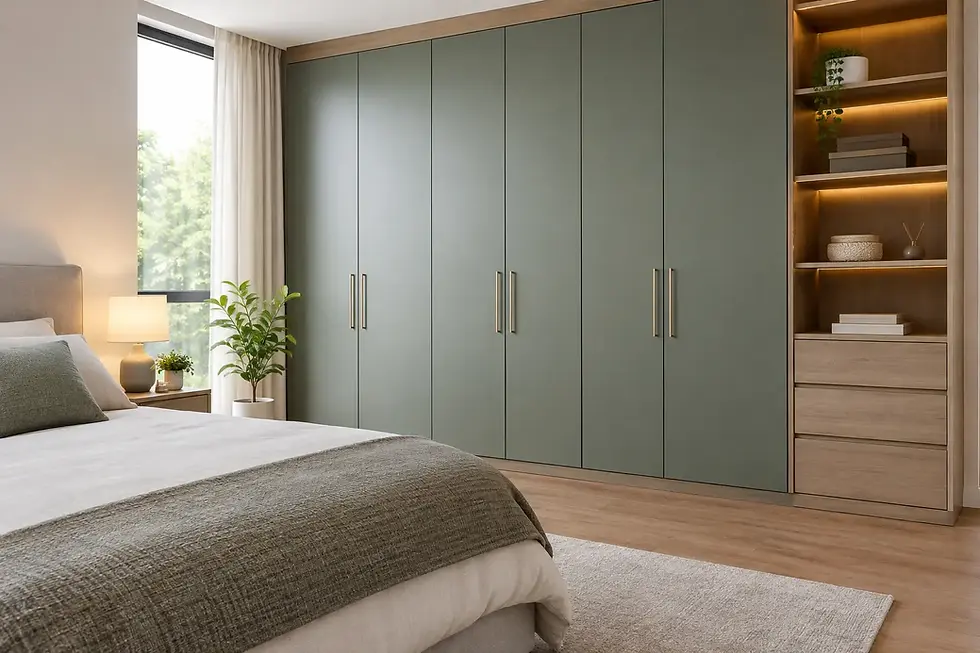
When installation is part of the same service, the fitters are working towards a result they already understand. They know how the wardrobe is supposed to sit, how the internal layout should line up and what finish the customer is expecting. That helps produce the kind of built-in look people usually want from fitted bedroom furniture - neat, integrated and made for the room rather than dropped into it.
It also makes problem-solving easier. If a small site issue appears during fitting, there is a clear chain of responsibility. You are not caught between separate suppliers blaming each other.
Design manufacture and install versus buying in pieces
Some homeowners compare bespoke fitted wardrobes with buying components separately. On the surface, splitting the job can look cheaper. You might source doors from one place, carcasses from another and ask a local fitter to assemble everything. In some cases, especially for very simple spaces, that can work well enough.
But there are trade-offs. Separate suppliers often mean separate priorities. One company may be focused on selling products, another on installation time, and neither may have full ownership of the finished result. Measurements can be passed along imperfectly. Design choices may be limited by standard sizes. If something does not fit, sorting it out can become a drawn-out process.
That does not mean bespoke is always the right answer for every budget or every room. If the space is straightforward and the expectations are basic, a modular option may be acceptable. The difference is that a true fitted solution is usually chosen because the room is not straightforward, the storage needs are specific, or the homeowner wants a finish that looks properly built in.
What homeowners gain from one joined-up service
The biggest benefit is confidence. You know who is responsible for the project, and you know the wardrobe is being shaped around your room from the start.
There is also a better chance of consistency. The design, materials and final installation are all moving in the same direction. That tends to show in the details - cleaner lines, smarter internal storage and a result that feels considered rather than pieced together.
For many customers, time and stress matter as much as the wardrobe itself. A managed service cuts down on chasing trades, repeating choices and trying to coordinate different parts of the job. That is especially valuable when the bedroom is in daily use and disruption needs to be kept sensible.
A local specialist such as Slideaglide can add another layer to that. You are not dealing with a distant supplier selling standard units at volume. You are working with a team that understands the practical expectations homeowners have when they are improving their own home.
The value is in the finished room
People rarely invest in fitted wardrobes for the wardrobe alone. They do it because they want the bedroom to work better. They want calmer mornings, cleaner lines, less wasted space and storage that does not feel like an afterthought.
That is why design manufacture and install matters. It keeps the focus on the end result, not just the individual parts. When the process is connected, the furniture has a better chance of fitting the room properly, suiting the way you live and lasting well.
If you are planning bedroom storage, it is worth looking beyond the doors and finishes and asking how the whole project will be handled. The quality of that process often decides whether the final room simply looks tidy or truly feels transformed.


Comments