
Fitted Wardrobes for Awkward Corners That Work
That unused corner in the bedroom is rarely as simple as it looks. A chimney breast creates an uneven return, a boxed-in pipe interrupts the wall, or a sloping ceiling leaves just enough room for dust to gather but not enough for a standard wardrobe. Fitted wardrobes for awkward corners are designed to change that, turning difficult shapes into useful, tidy storage that looks like it has always belonged there.
Freestanding furniture is made to suit the average room. Your room is not average, and it should not have to be. A made-to-measure design works around the angles, recesses and restrictions already in place, creating a finish that feels considered rather than compromised.
Why awkward corners need a bespoke approach
An awkward corner can waste far more room than its footprint suggests. Leave it open and it becomes a dead zone. Push a standard wardrobe against it and you are often left with a narrow, unusable gap at the side or above the top. It is frustrating to lose valuable storage space while the room still feels cluttered.
A fitted wardrobe is built to the exact dimensions of the space. That means the unit can run neatly from wall to wall, floor to ceiling, or be shaped around a sloped roofline. The corner becomes part of the design rather than an obstacle to hide.
This matters particularly in bedrooms where every centimetre counts. A well-planned wardrobe can replace a bulky chest of drawers, reduce visual clutter and give clothing, shoes and bedding a proper home. The result is not simply more storage. It is a calmer room that is easier to use every day.
Common awkward corners and how they can work
No two homes have identical walls, which is why the detail of the design matters. Some layouts call for full-height hanging space, while others are better suited to shelves and drawers. The best answer depends on what you need to store and how you use the room.
Chimney breast returns and alcoves
Chimney breasts often leave narrow alcoves on either side. These can be difficult to furnish with off-the-shelf wardrobes, especially where the depth changes along the wall. A fitted design can make the most of each side, with wardrobe interiors tailored separately if needed.
One alcove may be deep enough for hanging rails, while the other is more suited to shelving or drawers. Matching doors across both areas can still create a balanced, built-in look, even when the storage behind them is different.
Sloping ceilings and loft bedrooms
Loft rooms are full of character, but their angled ceilings can make furniture selection difficult. Standard wardrobes either sit too low beneath the slope or leave a large wedge of unused space above them.
A bespoke wardrobe can follow the roofline, using lower areas for drawers, shoes, folded clothes or seasonal bedding. Taller sections can be reserved for hanging. You may not gain full-height storage across the whole run, but you make sensible use of space that would otherwise be lost.
Corners beside doors and windows
The space next to a door frame or window can seem too narrow to be worthwhile. In reality, it can be ideal for shallow shelving, pull-out storage or a slim cupboard for smaller items. The key is allowing for door swing, window access, radiators and curtain poles from the outset.
This is where a careful measure makes all the difference. A wardrobe should improve the room’s layout, not make it feel tighter or block features you need to use.
Boxed-in pipes and uneven walls
Older properties can bring uneven plaster, pipe boxing and walls that are not quite square. These details are exactly why fitted furniture is so effective. Rather than forcing a rectangular cabinet into an irregular space, the cabinet is made around it.
The boxing can be concealed within the wardrobe structure while access is maintained where necessary. From the outside, you see clean doors and a polished finish rather than an assortment of gaps and fillers.
Planning the inside is just as important
A wardrobe may fit the corner perfectly, but it still needs to work for the people using it. Before choosing door styles or finishes, think honestly about what is currently causing the storage problem. Is it a lack of hanging space? Too many folded clothes? No proper place for shoes, bags or spare bedding?
For a couple sharing a wardrobe, separate sections can avoid the daily shuffle for rail space. For a family bedroom, lower drawers may make children’s clothing easier to reach. If the wardrobe is in a guest room, adjustable shelves and flexible compartments may be more useful than a large amount of permanent hanging space.
A practical corner wardrobe often combines different storage types. Full-height hanging is useful for dresses, coats and longer garments. Double hanging rails make better use of taller sections for shirts and trousers. Deep drawers keep smaller items out of sight, while shelves can hold knitwear, towels or storage boxes.
Do not assume every inch needs to be packed with fittings. Leaving a little flexibility can be worthwhile, especially if your needs are likely to change. A good design should suit your life now without becoming restrictive later.
Choosing doors for a tight layout
The door style has a real effect on how an awkward corner wardrobe feels in the room. Hinged doors offer a clear view of the interior, but they need enough room to open comfortably. In a compact bedroom, this may limit where the wardrobe can sit or how wide each door should be.
Sliding doors are often a strong choice along a long wall or where bed placement leaves little clearance. Because the doors glide rather than open into the room, they can keep walkways clearer. They also suit a clean, contemporary look, particularly with mirrored or glass panels.
There are trade-offs. With sliding doors, only part of the wardrobe is open at one time, whereas hinged doors allow full access across the interior. A design appointment is the right place to test these decisions against the actual room layout, rather than choosing on appearance alone.
Make the finish feel part of the room
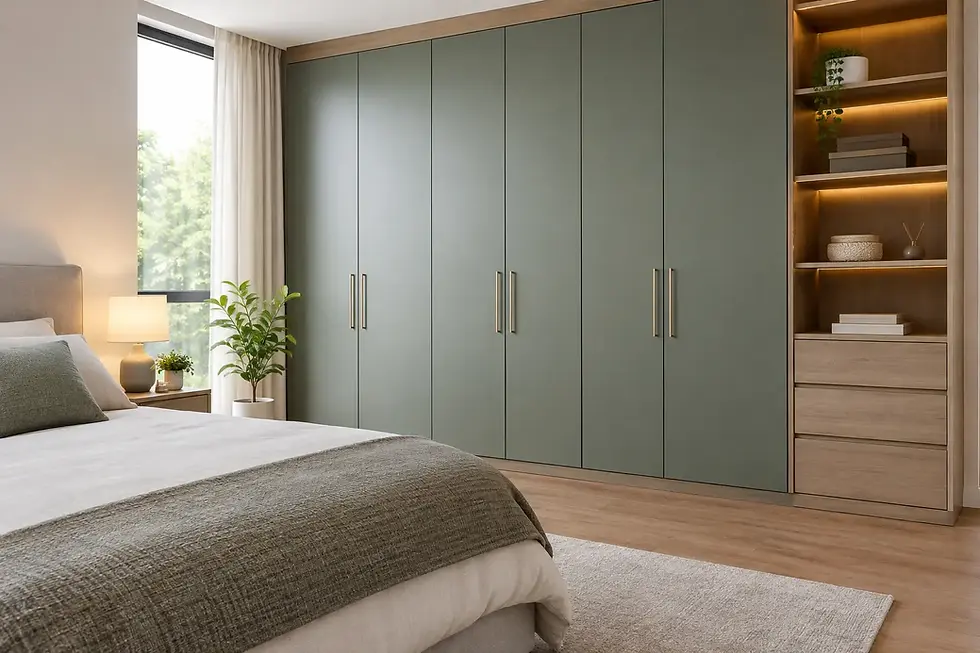
Awkward corners are most successful when the wardrobe looks intentional. A finish chosen to complement the bedroom can help a large storage solution sit quietly within the space rather than dominate it.
Lighter colours can help a smaller room feel more open, while wood-effect finishes add warmth and texture. Mirrored doors can reflect light and remove the need for a separate full-length mirror, although they do require more regular cleaning. For a softer, more traditional feel, panelled door styles and understated handles may be a better fit.
Floor-to-ceiling doors usually create the most integrated appearance and remove the dust-catching gap found above freestanding wardrobes. That said, a lower design can be the right choice beneath a window or steep ceiling slope. The room should lead the design, not the other way round.
From measurement to installation
The value of bespoke fitted furniture lies in the full process, not just the finished doors. Accurate measuring identifies the details that are easy to miss: skirting boards, sockets, coving, radiator pipes, ceiling slopes and walls that are out of true.
At Slideaglide, the design, manufacture and installation are handled as one joined-up service. This gives you a clearer route from the first idea through to the final fitting, with the wardrobe designed for your room rather than adapted from a standard range.
Before installation, clear the area as much as possible and decide which items will need immediate storage when the work is complete. It is also helpful to mention any concerns early, such as access to loft hatches, plug sockets or areas that need to remain reachable. Small practical decisions made at the planning stage prevent disappointment later.
A corner worth using
The best fitted wardrobes for awkward corners do not draw attention to the challenge they solved. They simply make a difficult part of the room feel useful, balanced and properly finished. Start with the things you need to store, the way you move around the bedroom and the features that cannot be changed. From there, even the most inconvenient corner can earn its place.


Comments