
Best Sliding Wardrobe Door Styles for Your Home
A wardrobe door can change how a whole bedroom feels. The best sliding wardrobe door styles do more than hide clothes - they shape the light, reflect the room’s character and make everyday storage easier to live with. The right choice depends on your room, your interiors and what you want the wardrobe to do visually.
For a small box room, a bright mirrored finish may be the practical answer. In a calm, contemporary main bedroom, a soft matt panel may suit better. And where the wardrobe runs across an awkward wall or into the eaves, a bespoke design gives you freedom that standard-sized furniture simply cannot.
Start with the room, not the door sample
Sliding doors are a strong choice because they do not swing out into the room. That makes them particularly useful beside a bed, in a narrow bedroom or where a dressing area needs to remain clear. But the finish of those doors should work with the room around them.
Look at the natural light first. A north-facing room may benefit from doors that bounce light around, while a bright room with lots of glazing can carry a darker, more dramatic finish. Consider what will sit opposite the wardrobe too. Mirrored doors will double the visual impact of whatever they reflect, so they work best when facing a tidy, attractive part of the room rather than a busy desk or laundry basket.
The scale matters as much as the colour. Large wardrobes with several wide panels can become a feature wall, whereas narrower door sections can feel more detailed and structured. A made-to-measure wardrobe lets the panel layout follow the proportions of the room rather than forcing the room to fit the furniture.
Best sliding wardrobe door styles to consider
Mirrored sliding doors
Mirrored doors remain popular for good reason. They create the impression of extra depth and light, and they remove the need to find wall space for a separate full-length mirror. They are often an excellent fit for compact bedrooms, loft rooms and homes where every square metre has to work harder.
Full mirror panels give the cleanest, most open look. For something softer, mirrors can be combined with coloured or wood-effect panels. This breaks up the reflection and makes a wide wardrobe feel less dominant.
The trade-off is upkeep. Mirrors show fingerprints, dust and smudges more readily than matt surfaces, especially in a family bedroom. They also require careful positioning. If you prefer a quieter, less reflective space, use mirror as one part of the design rather than covering every door.
Matt coloured doors
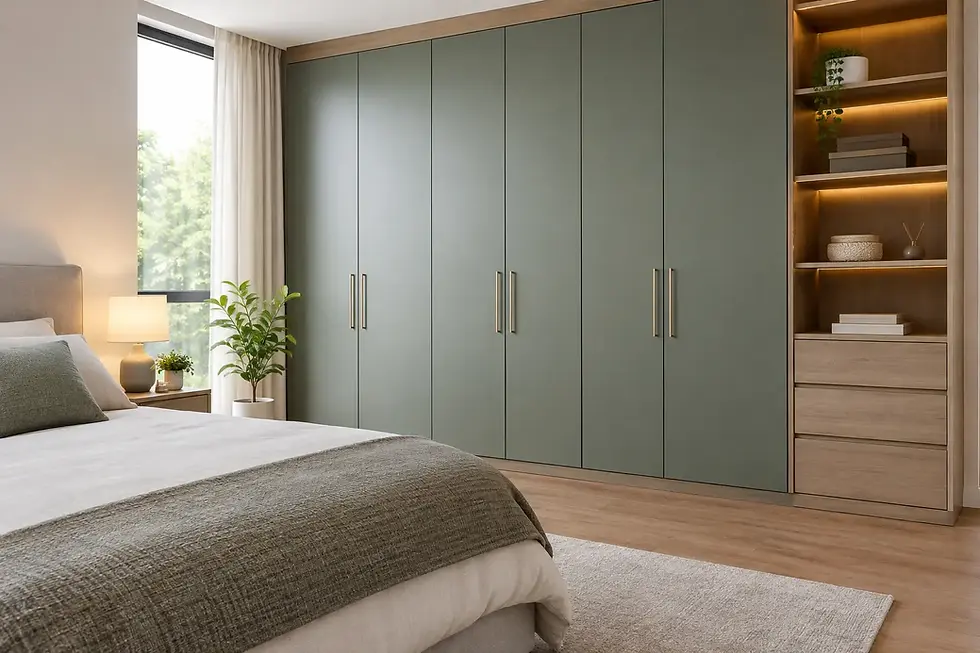
Matt doors have a calm, understated quality that suits modern bedrooms particularly well. Shades such as warm white, stone, cashmere, pale grey and muted green can blend into the walls for a fitted look, while charcoal, navy or black can create a more architectural statement.
A light matt finish is forgiving in day-to-day use and gives a room a soft, considered feel. It works beautifully with upholstered beds, textured throws and timber flooring because it does not compete for attention. Darker matt doors can look striking, but they need enough light and surrounding contrast to avoid making a small room feel closed in.
For a wardrobe that feels built into the room, choose a tone close to the wall colour. The wardrobe still provides generous storage, but the room feels calmer because the doors recede rather than stand forward.
Wood-effect sliding doors
Wood-effect panels add warmth without the weight or cost often associated with solid timber furniture. They can bring character to a newly decorated bedroom, balance cooler grey or white schemes, and suit both contemporary and more traditional homes.
Pale oak effects tend to feel fresh and relaxed, while walnut-inspired finishes bring depth and a more tailored look. A vertical grain can make a low ceiling appear higher, whereas a horizontal grain can make a wide wall feel even broader. These small details make a real difference on a large fitted wardrobe.
Wood effect is also a practical choice for busy households. Its pattern is generally more forgiving of minor marks than high-gloss or mirror doors. The key is matching the undertone to the rest of the room. A warm oak alongside cool grey flooring can feel disjointed unless another warm material, such as a timber bedside table or brass lighting, ties it together.
Glass and gloss doors
Coloured glass and gloss panels bring a sharper, more polished finish. They reflect some light without behaving quite like a full mirror, making them a good middle ground for homeowners who want brightness but not a fully reflective wall.
White, cream and pale grey glass can make a wardrobe feel clean and contemporary. Deep graphite, black or rich blue glass creates contrast and can make a larger bedroom feel more luxurious. Glossy finishes often look their best in simple schemes with uncluttered surfaces, where the wardrobe is intended to be a clear design feature.
Be realistic about cleaning. Gloss and glass can show smears, so they are better suited to rooms where a quick wipe-down is not a frustration. They can also feel colder than matt or wood finishes. Pairing them with soft furnishings, warm lighting and textured bedding keeps the room welcoming.
Panelled and framed designs
A sliding wardrobe does not have to look ultra-modern. Panelled or framed doors can introduce definition and a more classic feel, especially in period properties or bedrooms with shaker-style furniture. The frame can outline mirror, glass, wood-effect or coloured inserts, giving you plenty of flexibility.
This style works well when you want the wardrobe to feel like a piece of fitted joinery rather than a flat run of doors. Slim, dark frames offer an industrial edge, while softer neutral frames can feel more traditional. The more divisions you add, the busier the wardrobe becomes, so keep the design in proportion to the room.
Combining finishes creates a more personal design
Many of the most successful sliding wardrobes use two finishes rather than one. A central mirror panel with matt outer doors is a popular arrangement because it gives you useful reflection without overwhelming the room. Wood-effect panels alongside a warm neutral colour can add depth while keeping the overall look relaxed.
There is no fixed rule about symmetry. Symmetrical door layouts are calm and formal, while an asymmetrical mix can feel more contemporary. What matters is that the divisions line up thoughtfully with the width of the wardrobe and the furniture nearby.
At Slideaglide, the design stage is where these choices become easier to picture. Seeing how door finishes, panel widths and internal storage work together helps prevent a wardrobe from being chosen as an isolated item. It should feel like it belongs to the room from the first day it is fitted.
Do not overlook the inside of the wardrobe
Door style is what you see first, but internal layout determines whether the wardrobe stays useful. A beautiful run of sliding doors can still be frustrating if there is not enough hanging space, no sensible place for shoes, or drawers that are difficult to reach.
Plan around how you actually use your clothes. Long hanging is useful for dresses and coats; double hanging makes better use of height for shirts and trousers. Shelves suit knitwear and bags, while drawers keep smaller items from disappearing into piles. If two people share the wardrobe, separate zones usually make mornings easier.
Sliding doors also affect access. Because one section is always covered by another, the interior should be arranged so the things you reach for most are easy to get to. This is one of the advantages of a design-manufacture-install service: the inside and outside are planned as one solution.
How to choose with confidence
When comparing samples, take them into the bedroom and view them at different times of day. A colour that looks warm under showroom lighting can appear very different in morning light. Hold it against paint, flooring, curtains and bedding rather than judging it alone.
Think ahead as well. A very bold finish can be effective, but neutral doors are usually easier to live with if you like to refresh your décor every few years. You can bring personality through cushions, artwork and paint, while the wardrobe remains a reliable, long-term backdrop.
The best choice is the one that makes the room feel more spacious, keeps daily routines straightforward and reflects your own taste. Start with the way you want the bedroom to feel when the doors are closed, then let the storage behind them do the hard work.


Comments