
Custom Wardrobes for Box Rooms That Work
A box room can quickly become the place where clothes pile up, furniture does not quite fit and the door only opens halfway. The right custom wardrobes for box rooms change that completely. Rather than trying to make a standard wardrobe work in a space it was never designed for, fitted storage can be planned around every wall, corner and awkward angle.
For many Essex homes, the box room has a bigger job than its name suggests. It may be a child’s bedroom, a guest room, a home office with overnight use, or the only practical place for extra family storage. The aim is not to fill it with furniture. It is to create a room that feels useful, organised and comfortably proportioned.
Start with the room, not the wardrobe
The challenge with a small bedroom is rarely just floor space. Radiators, windows, sockets, sloping ceilings and the direction of the door all affect what will work. A freestanding wardrobe leaves gaps at the sides and above, which collect dust while wasting valuable storage. It can also make the room feel heavier because it sits proud of the wall.
A made-to-measure wardrobe is designed from the dimensions of the room itself. It can run floor to ceiling, fit tightly into an alcove or use a shallow wall that would otherwise be ignored. That means the available space is working harder without asking the room to accommodate an oversized piece of furniture.
This is where careful measuring matters. A wardrobe that is only slightly too deep can narrow the walkway around a bed or make drawers difficult to use. In a box room, every centimetre has a consequence. A good design considers how someone will move through the room as much as what they need to store.
Choose doors that protect floor space
Door choice has a major effect on how a compact room feels day to day. Sliding doors are often a strong option because they do not swing into the room. This is particularly useful where a bed is close to the wardrobe, or where the wardrobe sits opposite the bedroom door.
Hinged doors can still be the better choice in some layouts. They give full access to the wardrobe interior and can suit very narrow units or rooms where there is enough clear floor space in front. The decision depends on the room plan, not just appearance.
Mirrored sliding doors can make a box room feel brighter and more open by reflecting natural light. They are practical too, especially in a child’s room, dressing space or guest bedroom where there may not be room for a separate full-length mirror. For a softer look, plain panels in a light finish can visually recede into the wall, while a carefully chosen woodgrain can add warmth without overwhelming the room.
Build the inside around real belongings
A small wardrobe needs more thought inside than a large one. Simply adding a hanging rail and a shelf may look tidy at first, but it rarely supports the way a household actually uses the space. The best internal layout comes from an honest look at what needs to be put away.
For example, a child may need lower hanging space, shelves for folded clothes and easy-access drawers. A guest room may need a simpler arrangement with a hanging section, spare bedding storage and a shelf for luggage. A compact adult bedroom may benefit from double hanging for shirts and trousers, alongside a full-height section for dresses, coats or longer items.
Useful features often include drawers for underwear and smaller items, adjustable shelves, pull-down hanging rails for higher sections, and open shelving where daily essentials are easier to reach. Storage above the main hanging area is ideal for seasonal clothes, spare duvets or items that do not need to be accessed every week.
The goal is not to cram in as many fittings as possible. Too many divisions can make a wardrobe less flexible. A balanced interior gives everything a place while allowing room for needs to change over time.
Do not forget the space above and beside the bed
In some box rooms, the most effective answer is not a single wardrobe on one wall. Fitted furniture can extend around the bed, using space above a headboard for cupboards or incorporating slim units at either side. This can replace bedside tables and separate storage pieces, leaving more of the floor visible.
That said, overhead cupboards are not right for every room. They need to be positioned carefully so the bed still feels comfortable and the furniture does not create a closed-in effect. Lighter finishes, sensible depths and a simple door design make a real difference here.
Make a small room look calmer
A fitted wardrobe should solve a storage problem, but it should also make the room easier to live with. Visual clutter can make a compact bedroom feel much smaller than it is. Full-height doors with clean lines bring order to the wall, particularly when the finish complements the rest of the room.
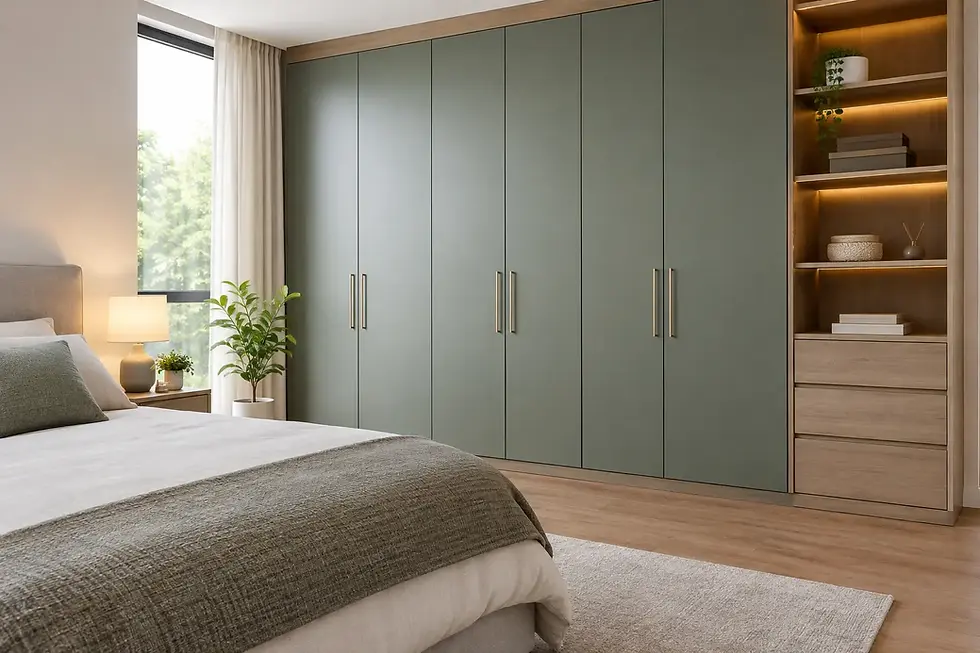
For a quiet, built-in look, many homeowners choose colours that sit close to the wall colour. White, soft grey, muted green and warm neutral tones can all work well depending on the light in the room. A handleless or minimal-handle style keeps the front clean, while framed doors can add character in a more traditional home.
Darker finishes are not automatically off limits. In a box room with good light, a deep blue, charcoal or rich wood effect can look purposeful and smart. The trade-off is that dark furniture has more visual presence, so it is usually best paired with a simple layout and lighter walls.
Lighting also deserves attention. A wardrobe positioned near a window should be designed to avoid blocking daylight. If the room is naturally dim, internal wardrobe lighting can make storage more usable, while a mirrored panel or well-placed wall light can help brighten the overall space.
Plan for the room’s next chapter
Box rooms often change use more than any other room in the house. A nursery becomes a child’s bedroom, then a study, then a dressing room. A tailored wardrobe should be able to support those shifts where possible.
This does not mean designing for every imaginable future. It means avoiding decisions that are too limiting. Adjustable shelving, sensible hanging sections and drawers that can serve different purposes give the furniture a longer working life. If the room may become an office, it may also be worth considering a wardrobe arrangement that leaves one wall free for a desk.
A fitted solution is particularly valuable in homes where moving furniture in and out of a small room is difficult. Once storage is designed properly, there is less need to keep replacing freestanding pieces as the household changes.
Why bespoke design makes the difference
Flat-pack furniture can be useful for a quick fix, but box rooms expose its limitations. Standard widths may leave unusable gaps. Standard heights often stop well below the ceiling. Doors and drawers are made for average clearances, not the exact layout of your room.
With a design-manufacture-install approach, the wardrobe can be shaped around the room rather than the other way round. At Slideaglide, that means discussing how the space is used, selecting finishes that suit the home and creating storage that is made for the final dimensions. Installation then brings the design together with the neat, integrated finish that makes fitted furniture worthwhile.
It is also a chance to resolve the details that are easy to overlook at the start: access to plugs, radiator clearance, skirting boards, uneven walls and where the bedroom door will sit when it is open. These are small points, but they are what separate a wardrobe that merely fits from one that feels as though it has always belonged there.
A box room can do more than store things
The most successful small bedrooms have one thing in common: they feel intentional. The wardrobe is not an obstacle squeezed in after everything else. It is part of the room’s layout, helping create clear floor space, easier routines and a calmer place to sleep, work or get ready.
Before choosing a style, stand in the room and consider the everyday moments - making the bed, opening the door, choosing clothes, putting washing away. A wardrobe designed around those simple actions will make the box room feel far more generous than its dimensions suggest.


Comments